The Importance of ATEX Certification in Fire Detection Systems

Osen Beste Koç
25 August 2025

In hazardous areas with explosion risks, it is not sufficient for fire detection and alarm systems to comply only with product performance standards such as EN 54; the equipment must also be certified to operate safely in explosive atmospheres. The European Union’s ATEX Directive (2014/34/EU), along with the parallel international IEC 60079 series, defines this safety.

In many industries such as refineries, petrochemicals, grain silos, flour mills, battery production, LNG/LPG facilities, and dusty processes, explosive atmospheres caused by flammable gases/vapors and/or dust can occur either periodically or continuously.

In such environments, fire detection systems face two main risks:

  • Becoming an ignition source themselves (spark, hot surface, static electricity, etc.),
  • Explosion resistance and operational continuity (integrity after an explosion, sealing according to the protection method).

ATEX certification verifies the equipment’s ability to manage these risks. Thus, alongside EN 54 performance requirements, the dimension of “safety in explosive atmospheres” is also guaranteed.

Basics of ATEX: Scope, Marking and Compliance

ATEX 2014/34/EU regulates the design, production, and conformity assessment of equipment and protective systems intended for use in explosive atmospheres. At this point, important classifications are made:

1- Equipment Groups

Group I: Underground mines and environments with firedamp (methane) risks.

Group II: Surface industrial plants where gases and vapors are present.

Group III: Surface industrial plants where combustible dust is present.

2- Equipment Categories

Category 1: Very high protection (Zone 0 or Zone 20 – continuous explosive atmosphere).

Category 2: High protection (Zone 1 or Zone 21 – where explosive atmosphere is likely to occur).

Category 3: Normal protection (Zone 2 or Zone 22 – where explosive atmosphere occurs rarely).

3- Types of Explosive Atmospheres (Gas/Dust)

G: For gas and vapor atmospheres.

D: For dust atmospheres.

4- Gas Groups

IIA: Less hazardous gases such as propane.

IIB: Medium-hazard gases such as ethylene.

IIC: Most hazardous gases such as hydrogen and acetylene.

5- Temperature Classes (T1–T6)

Defines the maximum surface temperature of a device:

T1: 450 °C

T2: 300 °C

T3: 200 °C

T4: 135 °C

T5: 100 °C

T6: 85 °C

The surface temperature must remain below the ignition temperature of the explosive gas.

Protection Methods and Their Relation to Fire Detection Components

Ex i (intrinsically safe): Circuit energy and temperature are limited below ignition level. Addressable/conventional detectors and manual call points are often chosen as Ex i. Intrinsically safe loops are designed with galvanic isolators or Zener barriers (EN 60079-11).

Ex d (flameproof): The enclosure contains the internal explosion and prevents the flame from escaping. Commonly used in sirens, flashers, and combined sounder-beacons requiring higher power.

Ex e (increased safety): In equipment that normally does not produce sparks, risks of sparks/heat are reduced even in fault conditions. Used in terminal boxes, junction boxes, and some alarm devices.

Ex t (dust protection): Enclosure-based protection in dust atmospheres (EN 60079-31). Critical for sirens/flashers in dusty processes.

Ex m, Ex p, Ex n: Less common but defined for specific applications.

Protection type must always be considered together with the zone and device class. For example, in a Zone 0 gas atmosphere, Ex ia intrinsically safe detectors and call points are selected, while in Zone 1, Ex ib or Ex d devices may be used.

Examples Marking:

II 2G Ex db IIC T4 Gb

II: Surface industries (non-mining)

2G: Category 2, gas → suitable for Zone 1

Ex db: Flameproof enclosure

IIC: Suitable for most hazardous gases (hydrogen, acetylene)

T4: Max surface temp 135 °C

Gb: High protection level

Such a beacon-sounder with this marking can be safely used in an LPG filling plant in Zone 1.

II 1D Ex ia IIIC T85°C Da

II: Surface industry (non-mining)

1D: Category 1, dust atmosphere → can be used in Zone 20 (continuous explosive dust atmosphere)

Ex ia: Intrinsically safe (highest protection level)

IIIC: Suitable for conductive dusts (e.g., metal dusts)

T85°C: Device surface temperature limited to 85 °C

Da: Very high protection level for dust (Equipment Protection Level)

A heat detector with this marking can be safely used in a metal processing facility with aluminum dust (Zone 20).

Fire Detection and Alarm Devices: EN 54 vs ATEX

Each device must comply with both EN 54 and ATEX requirements.
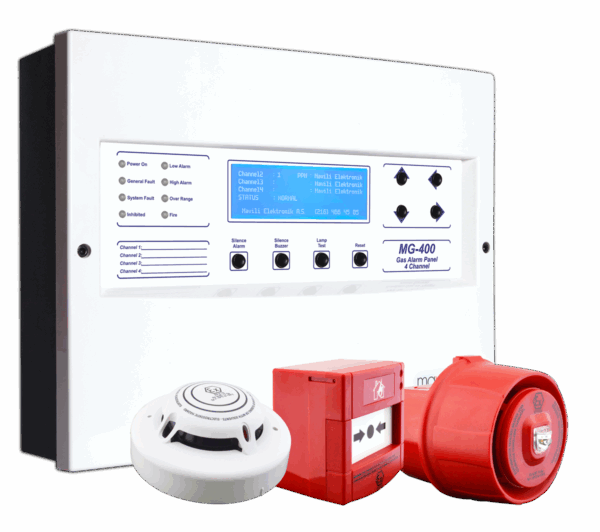
Detectors

EN 54:

EN54-5 (heat), EN 54-7 (smoke), EN 54-10 (flame), EN 54-20 (aspirating), EN 54-29 (multi-criteria).

ATEX:

Zone 0/1: Ex ia/ib (intrinsically safe, IS loop).

Dust Zones (20/21/22): Ex t (protected enclosure) or Ex ia.

Gas groups IIA/IIB/IIC, Dust groups IIIA/IIIB/IIIC.

T-class selection is mandatory.

Design/Installation:

IS calculations: line C/L values, barrier/galvanic isolator matching.

EN 54-14 layout rules (ceiling height, airflow, obstructions).

In aspirating systems, the pump must be in the safe zone; sampling pipes in hazardous zones must be antistatic and grounded.

Manual Call Points

EN 54:

EN 54-11

ATEX:

Zone 0/1: mostly Ex ia/ib.

Zone 1/21: Ex d enclosure solutions are also used.

Dust Zones: Ex t or Ex ia.

Design/Installation:

Housing/membrane must be UV and chemical resistant, with antistatic enclosure.

Transparent covers and seals should target IP66/67.

In IS circuits, proper barrier and cable shielding/earthing is mandatory.

Sounders

EN 54:

EN 54-3

ATEX:

High-power types: Ex d (flameproof); dust: Ex t.

Some low-power models: Ex e terminal compartment.

Design/Installation:

SPL calculation: required dB(A) + industrial noise margin.

Power budget/battery (EN 54-4) and line monitoring must be compatible with Ex design.

Ex d enclosures may reduce acoustic output → always use SPL data of the ATEX variant.

Beacons

EN 54:

EN 54-23

ATEX:

High-energy capacitors typically require Ex d (gas) or Ex t (dust).

Design/Installation:

Coverage calculation: manufacturer’s tables + mounting height.

Lens geometry; line-of-sight and reflection in fog/dust conditions.

If synchronization is required, the control module must also be ATEX-compliant.

Combined Sounder – Beacons

EN 54:

EN 54-3 + EN 54-23

ATEX:

Usually Ex d (gas) and/or Ex t (dust).

Design/Installation:

Power supply and battery calculations must include total and peak current (flash discharge).

Tone/flash synchronization; in large spaces consider flicker effects (migraine/vertigo).

Acoustic/optical shadowing analysis is necessary.

I/O Modules, Isolators, Interfaces

EN 54:

EN 54-17 (Isolators), EN 54-18 (I/O), EN 54-13 (system integrity).

ATEX:

Detection loops typically use Ex i.

Field junction boxes often Ex e enclosures.

Design/Installation:

IS parameter matching (Uo/Io/Po, Co/Lo).

Terminal spacing/clearance, cable shield management, equipotential bonding.

Control and Indicating Equipment (CIE) & Power Supply Units (PSU)

EN 54:

EN 54-2 (CIE), EN 54-4 (PSU/battery), EN 54-13 (system integrity).

ATEX:

Generally installed in the safe area.

All lines into hazardous areas must pass through ATEX-approved barriers/interfaces.

Pressurized (Ex p) enclosures may be used in special cases.

Design/Installation:

Battery backup duration: e.g., 24 h standby + 30 min alarm (or per local regulations).

External circuits must be monitored (short/open) in line with Ex requirements.

Cable glands, blanking plugs, junction boxes must be Ex e/Ex d/Ex t certified, IP66/67.

Cable selection must consider temperature and chemical resistance; shield must be earthed at one

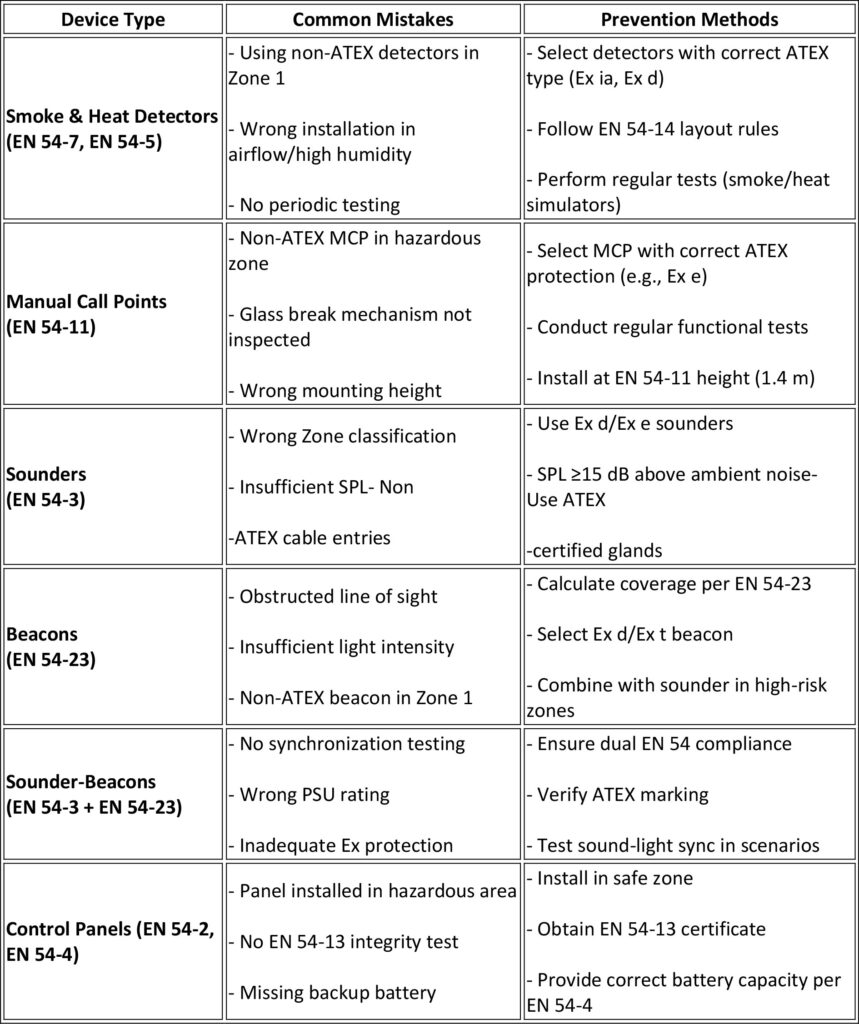
Common Mistakes and Preventive Measures

Additional Notes:

  • EN 54 compliance without ATEX is not acceptable in explosive atmospheres – dual compliance must be documented.
  • Wrong Zone–Category matching directly creates explosion hazards.
  • System topology must remain consistent with protection type.
  • In high-temperature environments, T-class must not be exceeded – process temperature should be reviewed seasonally.
  • Dust, dirt, lens degradation, and aging seals can reduce protection level and performance – preventive maintenance is essential.
Mavili Elektronik A.Ş. Builds Trust with ATEX-Certified Products

Since its establishment in 1987, Mavili Elektronik A.Ş. has been manufacturing fire and gas detection and alarm systems. With its newly developed ATEX-certified products that comply with EN 54 standards, Mavili offers reliable solutions for hazardous environments. Specializing in industrial safety and automation, Mavili delivers trustworthy solutions for critical sectors such as energy, chemical, oil, and gas industries, supported by high-quality standards and international certifications.

Mavili’s ATEX-Certified Products and Their Features

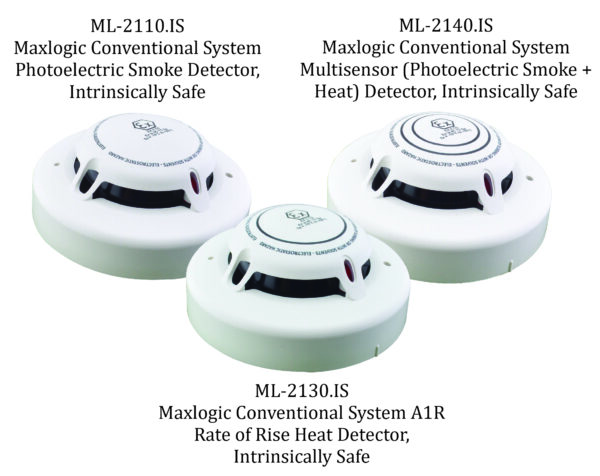
Intrinsically Safe Conventional Fire Detectors

  • Intrinsically Safe (I.S) for use in hazardous environments, compliant with EN IEC 60079-0:2018, EN 60079-11:2012, and EN ISO/IEC 80079-34:2020 standards
  • Compliant with EN 54-5 and EN 54-7 standards
  • IP 20 protection degree
  • 2 red LEDs (Constantly on in the event of an alarm), during normal operation, it flashes once every 8 seconds (for 1ms), and in the case of a fault (contamination or measurement error), it flashes twice
  • Dual LEDs with a 360° viewing angle, parallel indicator lamp output
  • Compatible with ML-0140.IS series detector bases
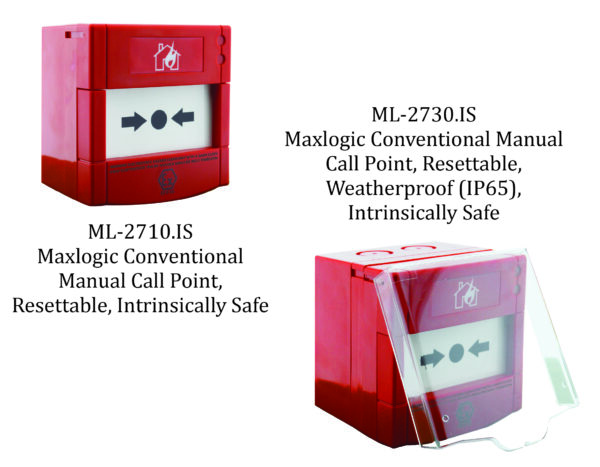
Intrinsically Conventional Call Points
  •  
  • Compliant with ATEX Directive EN IEC 60079-0:2018, EN 60079-11:2012, and EN ISO/IEC 80079-34:2020 standards
  • Designed in accordance with EN 54-11 standard
  • ML-2710.IS designed according to ATEX Ex II 1G EX ia IIC T4 Ga classification with -10°C≤Ta≤55°C
  • ML-2730.IS designed according to ATEX Ex II 1G EX ia IIC T4 Ga classification with -25°C≤Ta≤70°C
  • ML-2710.IS suitable for use in Category 1, 2, or 3 hazardous atmosphere environments and indoor areas up to 55°C
  • ML-2730.IS suitable for use in Category 1, 2, or 3 hazardous atmosphere environments and outdoor areas up to 70°C
  • IP65 protection degree
  • Ease of returning to the initial position by resetting
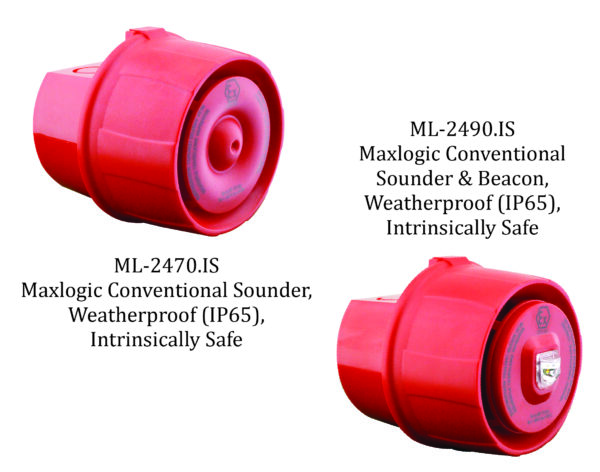
Intrinsically, Weatherproof Conventional Sounder / Beacon / Sounder Beacon
  • Compliant with ATEX Directive, EN IEC 60079-0:2018, EN 60079-11:2012, and EN ISO/IEC 80079-34:2020 standards
  • Compliant with EN 54-3 and EN 54-23 standards
  • Designed according to ATEX Ex II 1G EX ia IIC T4 Ga classification, with an operating temperature range of -25°C≤Ta≤70°C
  • Suitable for use in hazardous atmospheres of Category 1, 2, or 3 with temperatures up to 70°C
  • IP65 protection rating
  • Equipped with 32 distinct sound tones. Sound tones and their high/low settings can be adjusted via dip switche
  • Audible, visual, or combined fire alarm notifications from control panels

With over 38 years of innovation-driven and customer-focused experience, Mavili Elektronik continues to make a difference in industrial safety.

Learn more at: www.mavili.com.tr

  •